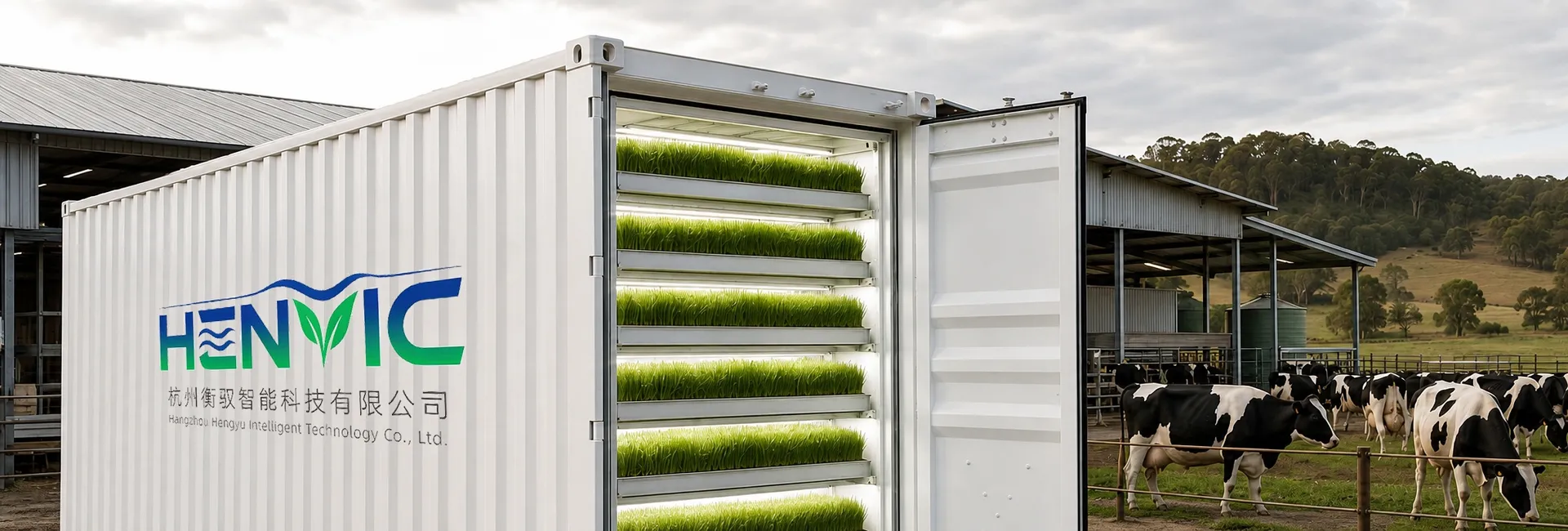
Stacking multiplies floor area, but the ceiling is set by geometry, not by steel
The premise of vertical farming is disarmingly simple: if a plant needs a footprint but not much headroom, then put more plants in the air. A single container offers perhaps thirty square metres of floor and something like twice that in usable growing surface once a modest three-tier rack is installed, and the multiplication continues with every tier added. The temptation is to read the rack as a dial — turn it up, harvest more. That reading fails immediately against the physics. Every tier added is a new crop demanding its own light, its own airflow, and its own share of a fixed envelope of height. Space utilization and light-path allocation are not two problems that happen to coexist in a container; they are the same problem viewed from two directions, and the solution to the second bounds the achievable value of the first.
The height budget is the governing constraint
A container's internal height is a hard number, fixed at manufacture and not negotiable during operation. Subtract the floor structure, the ceiling plenum for air handling and wiring, the reservoir or drainage space at the bottom of each rack, and the depth of the luminaire itself, and what remains is the total vertical space available for growing. This remaining budget must then be divided among tiers, and every division is a trade.
Give each tier more headroom and you accommodate a taller crop and a luminaire with better thermal clearance, but you reduce the number of tiers and therefore the total growing area. Compress the tiers to fit one more row and you gain surface — but you have imposed a new set of penalties on light delivery, canopy development, and airflow that may cancel the gain entirely. The tier count is thus not an independent variable to be maximized. It is the outcome of a calculation in which the marginal tier must pay not only for its own structure and luminaire but for the degradation it inflicts on the tiers around it.
Light attenuation and the inverse-square problem
The reason vertical spacing is so consequential lies in how light behaves with distance. For a compact source, irradiance falls with the square of the distance, so doubling the gap between a luminaire and the canopy quarter the photon flux density arriving at the leaves. Modern horticultural luminaires are deliberately designed as extended sources with wide, diffuse emission profiles precisely to soften this falloff, and a well-designed bar fixture illuminates a target plane far more uniformly than a point source would. But no optical design abolishes the inverse-square relationship; it only flattens the gradient within the working distance the fixture was engineered for.
Two practical consequences follow. First, every luminaire has a designed throw distance — the range over which its emission is acceptably uniform — and positioning a canopy closer than that (to squeeze in an extra tier) may raise intensity but also concentrates it unevenly, with hot spots directly beneath the emitting elements and dim regions between them. Second, the falloff determines the usable vertical tolerance at each tier: if the crop grows from seedling to harvest within a tier, the canopy rises through that distance, and the light reaching it changes as it does. A tier designed for a 5 cm seedling must still deliver adequate DLI when that seedling becomes a 25 cm lettuce, and the intensity at the top of that range may be less than half what it was at the bottom.
DLI allocation: the fair-share problem
The daily light integral — the total moles of photosynthetically active photons delivered per square metre per day — is the quantity that ultimately drives yield, and it must be met at every tier, not merely on average. This makes the stack an allocation problem.
If a single luminaire at the top of a rack were asked to serve several tiers beneath it, only the uppermost would receive its design DLI, and each successive tier would be starved. This is why each tier carries its own dedicated luminaire in practice: the light path is deliberately kept short and self-contained, one fixture per growing level, so that the DLI at tier three does not depend on how much of the photon stream survived the passage through tiers one and two. The cost of this architecture is that total lighting power scales with tier count, and since lighting already dominates the electrical load of a container farm, the energy bill scales with it in lockstep. The stack that maximizes growing area simultaneously maximizes the lighting load, and the two cannot be decoupled.
The schedule offers a partial release valve. Because DLI is the product of photoperiod and intensity, a farm can reduce fixture power per tier and extend the photoperiod, offsetting the higher tier count with lower per-tier intensity. This works only up to the limits imposed by crop physiology and by the daily dark requirement, and it interacts with the facility's tariff structure and its cooling load — because every additional hour of lighting is also an additional hour of heat that must be removed. The allocation of DLI across tiers is therefore entangled with energy cost, not just with agronomy.
Uniformity within a tier, not only between tiers
A stack is often discussed tier by tier, but each tier is itself a two-dimensional field, and the uniformity problem recurs at that scale. A luminaire mounted along the centreline of a wide tier produces a distribution that peaks beneath the fixture and falls off toward the edges; the plants at the margins receive less light than those in the middle. Over a crop cycle this produces a visible gradient in growth, with the edge rows stunted relative to the centre. The remedy is either narrower tiers — accepting less growing width per luminaire — or luminaire layouts engineered for a flatter field, or reflective sidewalls and end panels that return oblique light to the canopy. Each choice trades capital and complexity against uniformity, and the acceptable degree of non-uniformity depends on how much batch consistency the market requires.
Vertical uniformity matters within a tier as well. A plant is not a flat surface; its upper leaves receive the full incident flux while its lower leaves are shaded by the leaves above. Within a dense canopy, light is attenuated roughly exponentially with depth, so a significant fraction of the leaf area operates below light saturation. The architecture of the canopy — controlled by the blue-to-red ratio, by planting density, and by truss or pruning management — determines how much of the plant's total leaf area sees useful light. A tier that delivers an excellent DLI to the canopy surface can still underperform if the canopy is so dense that the light stops in the top few centimetres.
Airflow is the invisible cost of tight spacing
Light is the constraint most often discussed in vertical systems, but airflow is the one most often underestimated, and it is the constraint most directly aggravated by aggressive stacking. A tier is not merely a platform for plants; it is a partition that obstructs the flow of air through the rack. The closer the spacing, the thinner the gap through which air must pass, and the more the tier above shelters the tier below from the circulating stream.
The result is a thermal and humidity stratification that varies with height. Heat generated by the luminaires rises into the gap beneath the next tier, where it can accumulate if the airflow does not sweep it away, and the warm, moist air leaving the lower canopy rises into the layer above. Temperatures at different levels of a poorly ventilated rack can diverge by several degrees, and this divergence is self-reinforcing: the warmest tiers transpire fastest, loading the air above them with moisture, which further warms and saturates the layer above. Because vapour pressure deficit — the quantity that actually governs transpiration — depends on both temperature and humidity, a gradient in one produces a gradient in the other, and the crop at different levels experiences genuinely different growing conditions despite being in the same box.
There is also a condensation hazard specific to tight stacks. Perforated trays carrying the canopy limit vertical air movement, and under the humid conditions that prevail in the lower canopy, the underside of a tray can fall below the dew point, producing condensation that drips onto the canopy below. That water is an inoculation route for fungal and bacterial disease, and it is generated not by an error in humidity setpoint but by the cumulative effects of close spacing and insufficient air movement.
Spacing, ventilation, and the marginal tier
The practical lesson is that tier spacing is set by the requirements of the most demanding plant in the system, not by the mean. A tier configured for a compact seedling may accommodate a slightly taller form with no apparent penalty, but if the same spacing is applied to a crop that reaches twice that height, the consequences appear first in airflow, then in humidity stratification, then in disease.
This is why the marginal tier deserves an honest accounting rather than an optimistic one. Adding a tier raises the gross growing area, but it also raises the lighting load, tightens the airflow gaps, reduces the headroom available to the crop, and may compromise the light uniformity at every level. The relevant question is not whether the extra tier can be fitted but whether, once fitted, it produces a positive contribution after accounting for the yield losses it imposes on the tiers it has crowded. In many container designs the answer flips at the fourth or fifth level, where the management of heat, humidity, and light becomes qualitatively harder rather than merely more intensive.
The stack is a system, and its ceiling is the point where the parts stop cooperating
Thinking of vertical stacking as a multiplication of floor area is useful only as a first approximation. The real determinant of how many tiers a container can profitably hold is the interplay of four coupled variables: the height budget, which fixes the spacing available; the light path, which sets the uniformity and intensity achievable at each level; the DLI requirement, which sets the lighting load and therefore the energy cost; and the airflow, which determines whether the microclimate at each tier is actually what the control system believes it to be. Each of these improves as spacing increases, and each deteriorates as tiers are compressed.
The design question is therefore not how many layers will fit but at what level the addition of another layer stops paying. That turning point arrives when the incremental growing area no longer compensates for the lighting energy it requires, the crop quality it compromises through reduced uniformity, and the microclimate control it makes harder. A well-designed container farm is one whose tier count sits just below that point — which is to say, one whose stacking is determined by the physics of light and air rather than by the dimensions of the box.