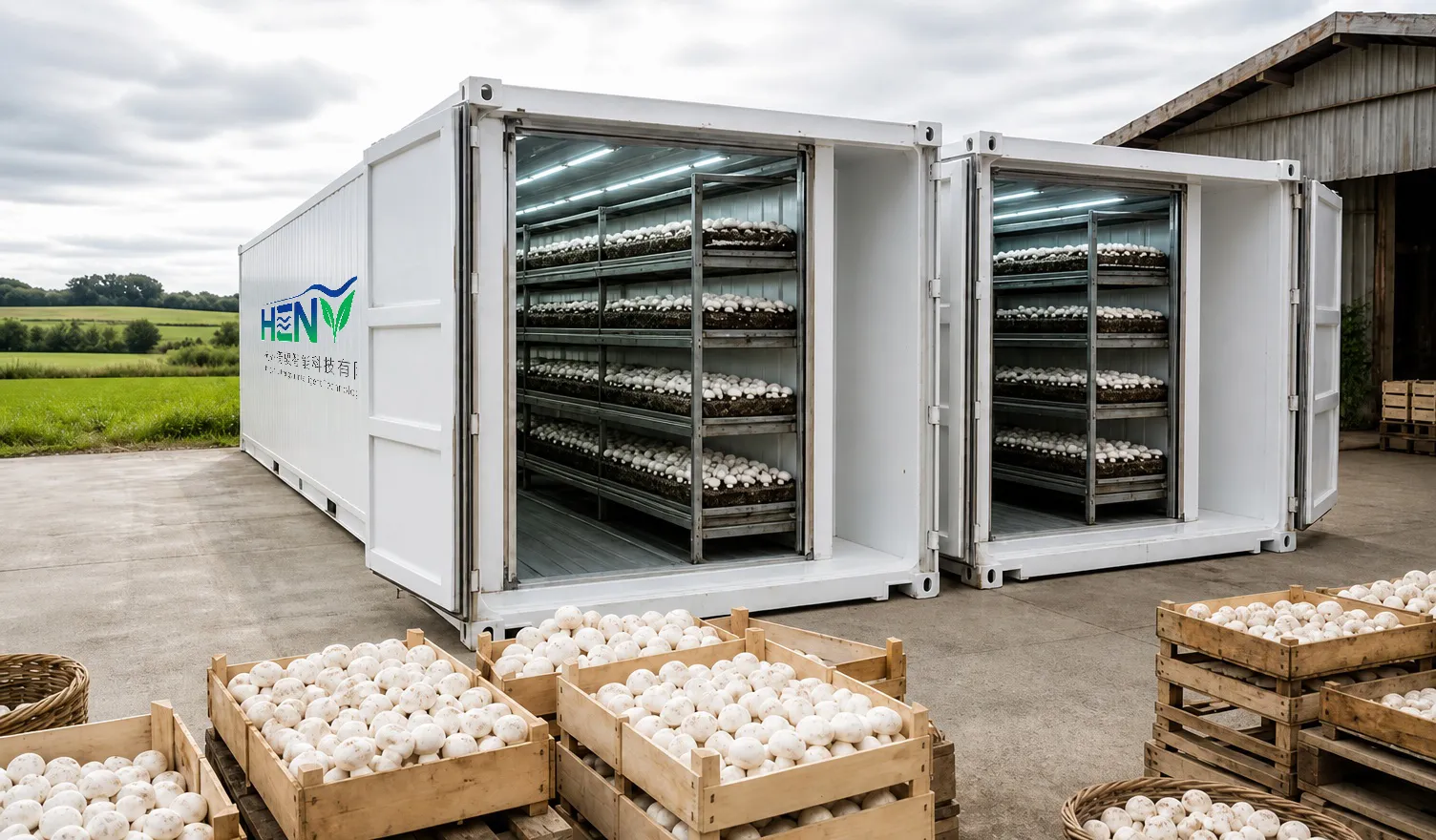
A sealed container is not a sterile one. The same closure that excludes airborne pests and reduces pesticide use also concentrates any contamination that gets in, removes the predators that would otherwise keep populations down, and offers ideal conditions — 22 °C, high humidity, continuous host availability — for the organisms that do establish. Control strategy has to be built around that paradox.
Environmental control architecture comes first because everything else depends on it. A container farm needs independent, monitored control of temperature, VPD, CO₂ and photoperiod, with sensor redundancy on the two variables that can destroy a crop within hours: temperature and irrigation. The practical arrangement is a primary controller with local logic that continues to run the irrigation pump, the fans and a safe lighting schedule if the network drops, plus a cloud layer that handles recipes, alarms and reporting. Cloud-only architectures fail exactly when they are most needed.
Sensor placement determines whether the control loop is regulating the crop or the wall. Air temperature and humidity should be measured at canopy height in at least two locations — one at each end of the rack run — because the stratification along a 12 m container is routinely 2–3 °C and 8–12% RH. The controller should act on the average, alarm on the spread, and treat a widening spread as an airflow fault rather than a setpoint problem. CO₂ sensors based on non-dispersive infrared drift and require fresh-air or reference-gas calibration every six to twelve months; an uncalibrated sensor reading 200 ppm high will cause chronic over-enrichment, which is a cost with no yield benefit at concentrations above about 1200 ppm for most leafy crops.
Sanitation is the discipline that most container operations under-resource, and the condensate is the reason. Cooling coils, defrost drains and plenum surfaces stay wet for most of the operating day, and they are the classic reservoir for Listeria in refrigerated food environments. The design responses are straightforward and cheap at the drawing stage: slope all drain pans to a trapped discharge, avoid hollow sections and enclosed C-channels that cannot be cleaned, use open-frame racks, and specify smooth, non-porous wall and floor finishes with coved junctions. Between cycles, the room should be cleaned and sanitised on a documented schedule with a validated contact time — and the irrigation lines, which are the highest-risk surface in the whole facility, should be disinfected as a matter of routine rather than after a problem appears.
Irrigation water treatment doubles as pest and pathogen control. UV at 40–80 mJ/cm² on the return line, plus filtration at 100–200 micron, breaks the root-to-root transmission route for Pythium and Fusarium, which is the dominant infection pathway in recirculating systems. The dose must be verified by transmittance measurement, not by lamp hours.
For insect pests in a sealed room, the practical programme is exclusion plus scouting plus biologicals. Exclusion means positive pressure, filtered make-up air, sticky monitoring cards at every tier and a controlled entry protocol — thrips and aphids arrive on people, on plant material and on packaging, not through the walls. Scouting on a fixed schedule with a written threshold per tier catches an incursion while it is still localised. For the species that do establish, predatory mites and parasitic wasps work well in the stable environment of a container, provided the application is timed to the pest's generation time and the predators are not wiped out by a subsequent chemical application. Rotating active ingredients against a small closed population is how resistance develops; the better answer in a sealed system is to avoid chemistry where possible and to accept that a failed biological programme means destroying and restarting the affected tier rather than spraying the room.
Documentation ties the whole thing to a food safety standard. A container farm selling to retail or food service will be audited against a produce safety framework that expects a water testing regime, a sanitation schedule with verification records, a pest monitoring log and traceability from tray to delivery. Building those records into the control system from the start costs little; retrofitting them after an audit finding costs considerably more.